


Increasingly, the world looks to Asia for where the future of culture is headed. Outsized growth in China, India, and the ASEAN nations is setting the region up to become one of the world’s leading cultural powerhouses.
One of the ways we might understand the future of culture is through art. Art gives you a view into what some of the world’s leading minds are thinking about. The medium answers some of the most important questions in culture: What issues are becoming important to artists, curators, and creatives? How are these points of concern being translated into painting, sculpture, sound, photography, graphics, or filmmaking? At an even more fundamental level: How are forms of expression actively changing in real time? And why?
Understanding art means understanding where the world is headed.
Enter Adam Insight’s newest bite-sized report: THE FUTURE OF ART IN ASIA. We asked some of the leading curators in our city what aesthetic and art trends are rising, what visual and aesthetic styles feel particularly “of the moment,” and what forces—social, economic, political—are shaping them.
Through a series of mini-essays, we’re looking into the perspective of the region and how its players are envisioning the development of the Asian art scene.
EXPERTS INTERVIEWED:
1. Daniel Ho, Executive Editor @ CONG Journal.
2. Renee Lui, Curator @ N+ Museum and The Ward
3. Joseph Chen, Director of Culture @ Eaton HK
4. Kenny Li, Director of Culture @ Heath Mall
5. JY Yan, Insights @ Inner Chapter; ex-Social Media Lead @ Radii
6. Eunice Tsang, Curator @ M+ and Current Plans
1. Daniel Ho, Executive Editor @ CONG Journal.
2. Renee Lui, Curator @ N+ Museum and The Ward
3. Joseph Chen, Director of Culture @ Eaton HK
4. Kenny Li, Director of Culture @ Heath Mall
5. JY Yan, Insights @ Inner Chapter; ex-Social Media Lead @ Radii
6. Eunice Tsang, Curator @ M+ and Current Plans
NOTE: this report is much easier to read on desktop/email.

One direction I think will continue moving from contemporary art into wider visual culture is a cluster of overlapping tendencies: ritual, “ancestral” or “traditional” references, ecological thinking, and material intensity.
Over the last few years, strands that once felt distinct have increasingly appeared in combination. What is emerging is not a return to tradition, but a highly contemporary field shaped by atmosphere, bodily presence, and symbolic charge. Many artists work through video, sound, performance, installation, and digitally aware image-making, even when drawing on older cosmologies or inherited forms.
This feels especially pronounced in Southeast Asia. Thailand, Indonesia, and the Philippines come to the fore, because artists there often move fluidly between spiritual symbolism, vernacular forms, performance, and contemporary media.
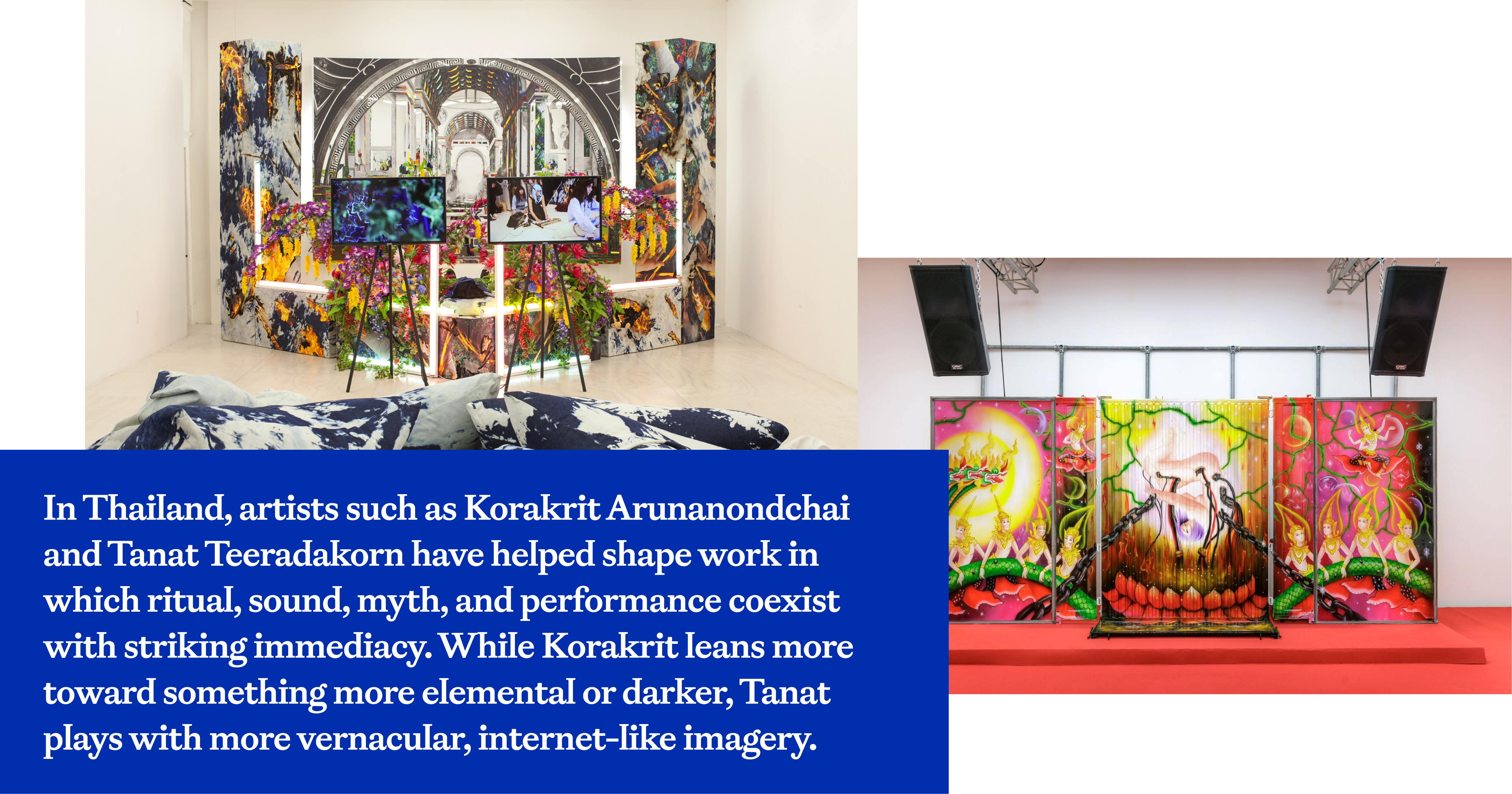
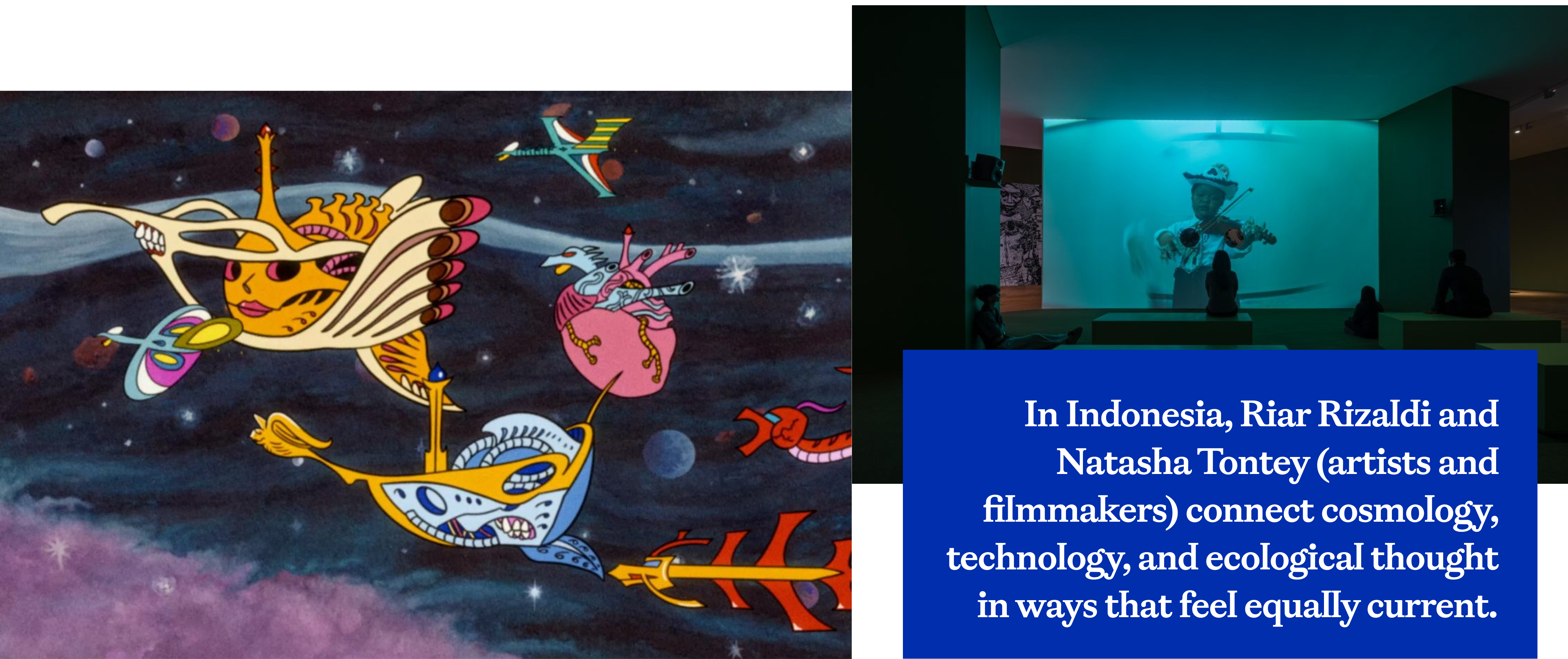
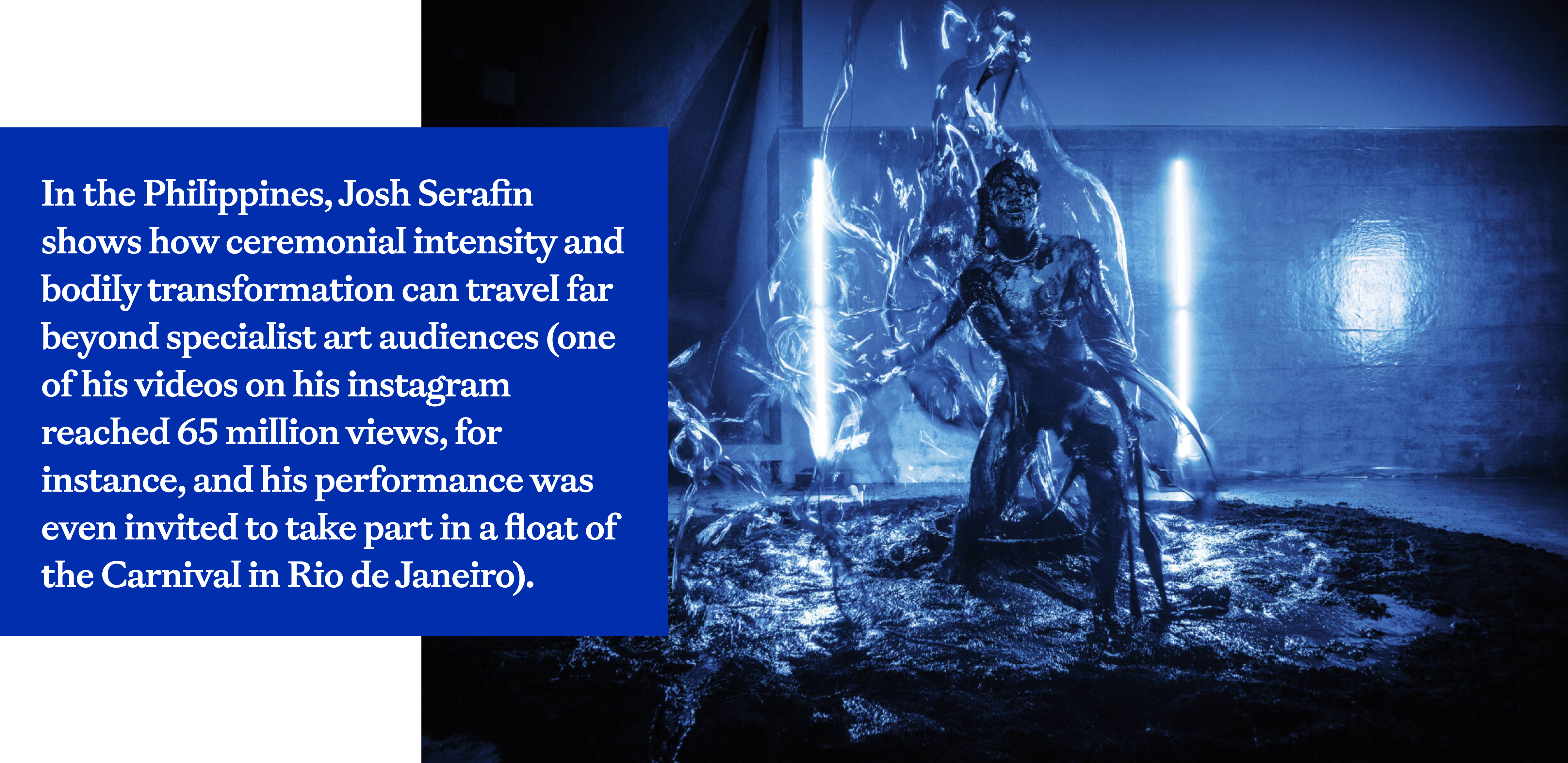
Part of the reason is a growing sense that the thinking and visual languages of the recent decade no longer fully answer the present moment. Climate anxiety has made urgent the questions of land/sea, material extraction, and the given state of the world. At the same time, many artists seem drawn to symbolic systems that sit outside modern rationalism alone, outside of the “Western Reason”—cosmology, ritual, myth, and older forms of knowledge become ways of thinking through uncertainty rather than simply quoting tradition. In a more visibly multipolar world, these references no longer feel peripheral.
If Southeast Asia often approaches this through indigenous thinking, postcolonial memory, or ritual forms that remain legible to a broader audience, in the Sinosphere the same search often arrives differently. In China, one sees artists turning toward internal regions such as the Northeast and Southwest (and Zomia), looking beyond a simple nation-state frame through border histories, peripheral landscapes, and local temporalities. Others move through myth and image systems in more mediated ways:
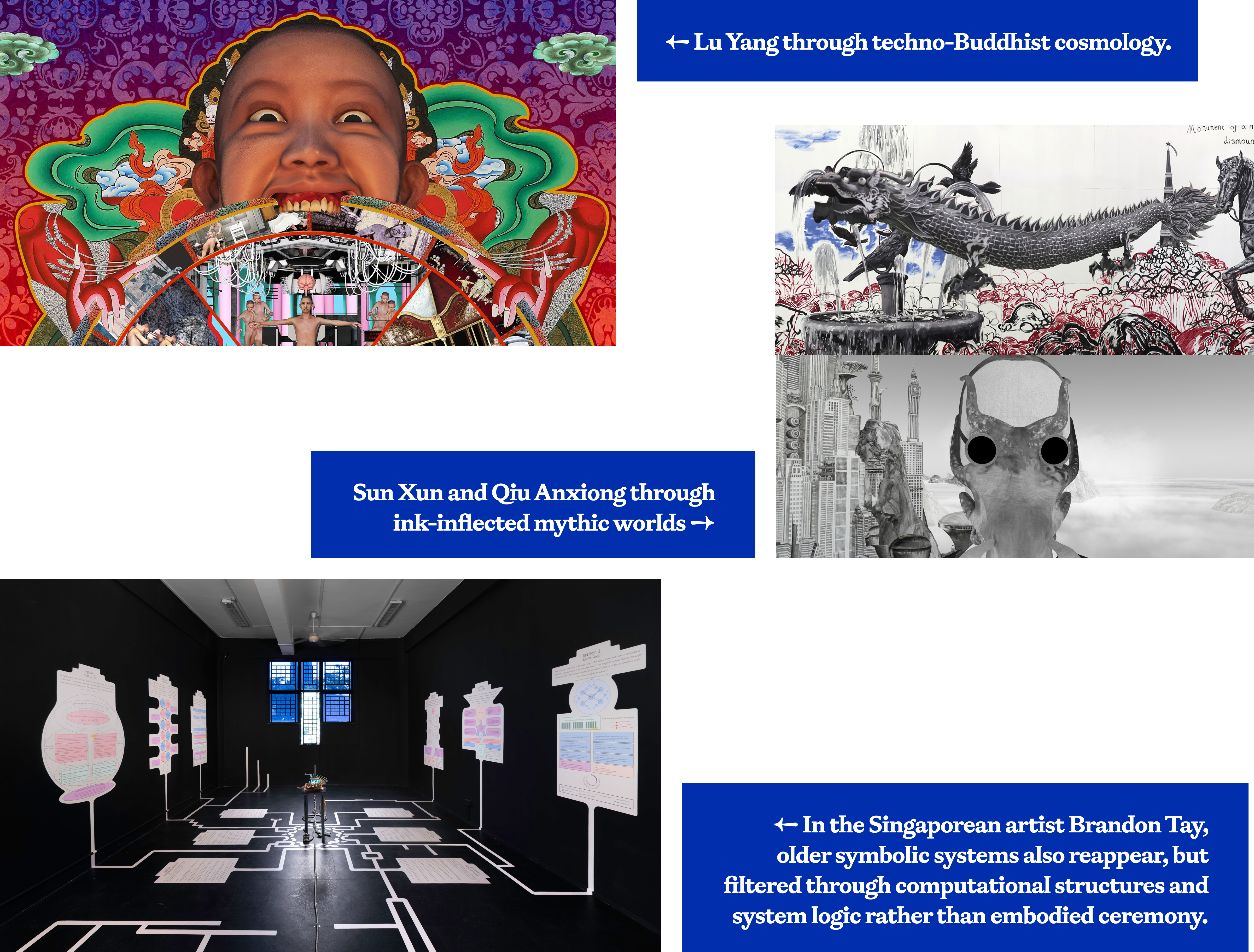
Within many national contexts, these tendencies are sometimes treated as peripheral rather than central—tied to border regions, older knowledge systems, or non-dominant histories. For that reason, they may sometimes gain traction internationally before they do domestically, where an outside gaze reads them simultaneously as distinctly Asian and unmistakably contemporary.
If this cluster of symbolic and conceptual references enters the mainstream, it will probably do so less as contemporary art than as atmosphere: denser textures, ceremonial moods, and imagery that feel both very much tied to a history or tradition and yet appear to be of the present moment.

We’re seeing a return to materially rich, technically rigorous practices — characterised by muted palettes, layered textures, and conceptual depth, often engaging with historical and cultural discourse as a counterpoint to hyper-pop and digital aesthetics.
Technically dense, detail-oriented works with muted colour palettes; heavily textured, object-driven practices with a sense of patina and historical resonance. A renewed interest in surrealism, particularly in its more introspective and symbolic registers, alongside emerging neodeco tendencies—marked by ornamental precision, stylisation, and the reinterpretation of historical references through a contemporary lens. Practices that emphasise materiality, symbolism, and layered meaning.
Driving this is a growing fatigue—and underlying anxiety—around AI and the proliferation of low-quality, algorithmically generated content. As digital spaces become saturated with fast, two-dimensional imagery, there is an increasing awareness of consumption habits and a corresponding desire for works that offer intellectual, cultural, and material depth. This shift reflects a broader move away from “content” toward art that demands time, attention, and contemplation.
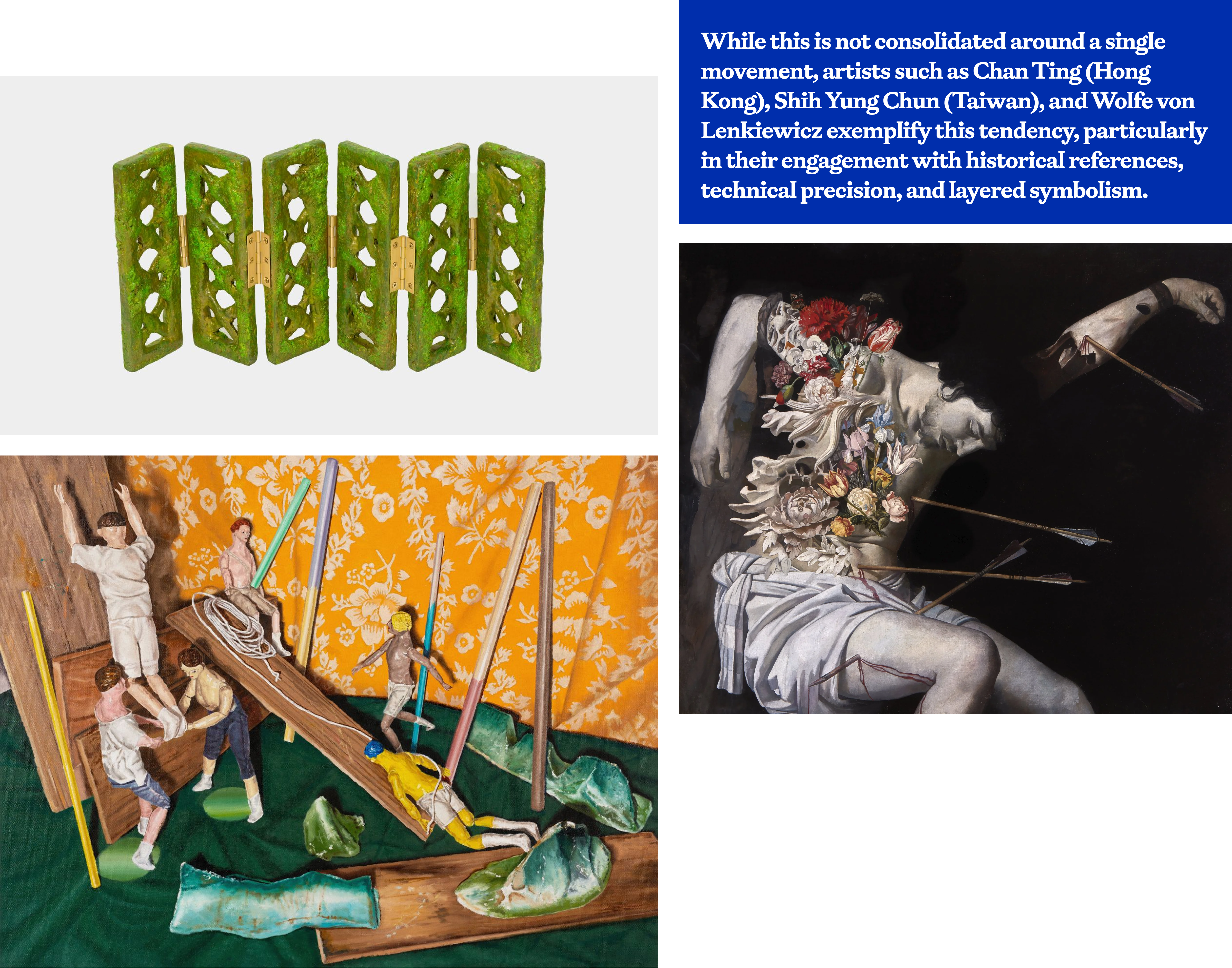
This shift signifies a broader return to humanistic values in both art and society. At a moment when AI increasingly mediates visual culture and social media accelerates consumption into “brain rot,” these practices reassert the value of slowness, material presence, and critical engagement.

What’s one art trend I think will become mainstream in 2026? Systems thinking as aesthetic practice. We’re moving from identity as the dominant framework of contemporary art toward a deeper interrogation of the infrastructures that produce identity in the first place: the algorithms, logistics networks, colonial archives, platform economies, and institutional machineries that quietly determine who gets seen, how, and on whose terms.
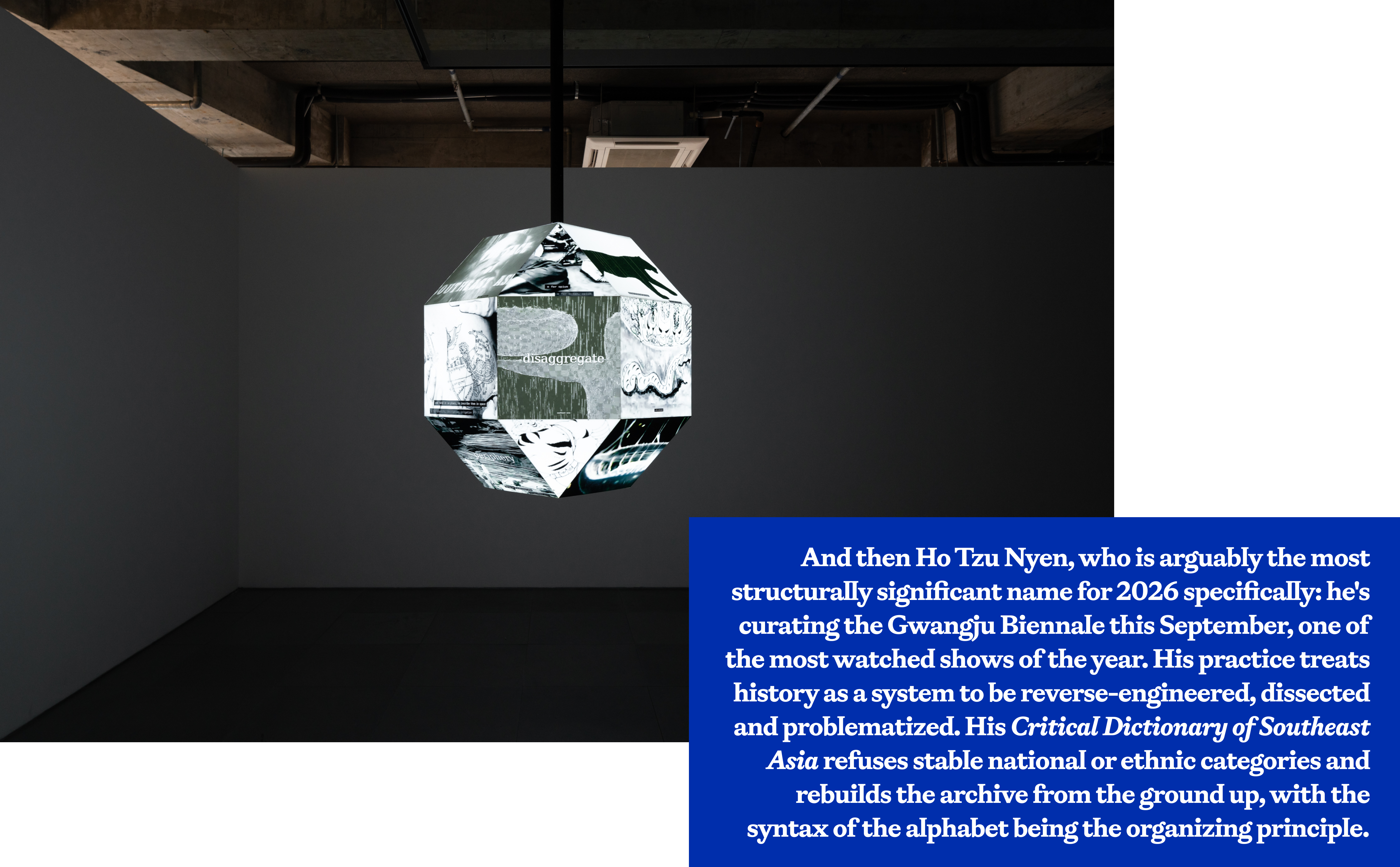
The visual language is already coalescing: multi-channel video installations that map networked systems, speculative world-building that uses game engines and generative AI as a structural metaphor; working with the archive and counter-archival practices that treat history as a system to be reverse-engineered. What these share is an interest in the apparatus. It’s less about expressing a self but rather it’s about exposing the conditions under which selves are made legible or erasable.
Identity as an art world currency has run its course not because the questions it raised were resolved, but because institutions learned to absorb and commodify it. Representation became a kind of programming strategy. The critique was neutralized by the market it was critiquing. What systems thinking does is go one layer deeper, and crucially, it implicates the institution itself. That’s harder to fully domesticate. The broader context matters too: gig economy precarity, AI restructuring what labor and authorship mean, platform capitalism making the infrastructure of daily life newly legible and newly alarming. Artists are responding to a moment when the machine is no longer background noise — it’s the main character.
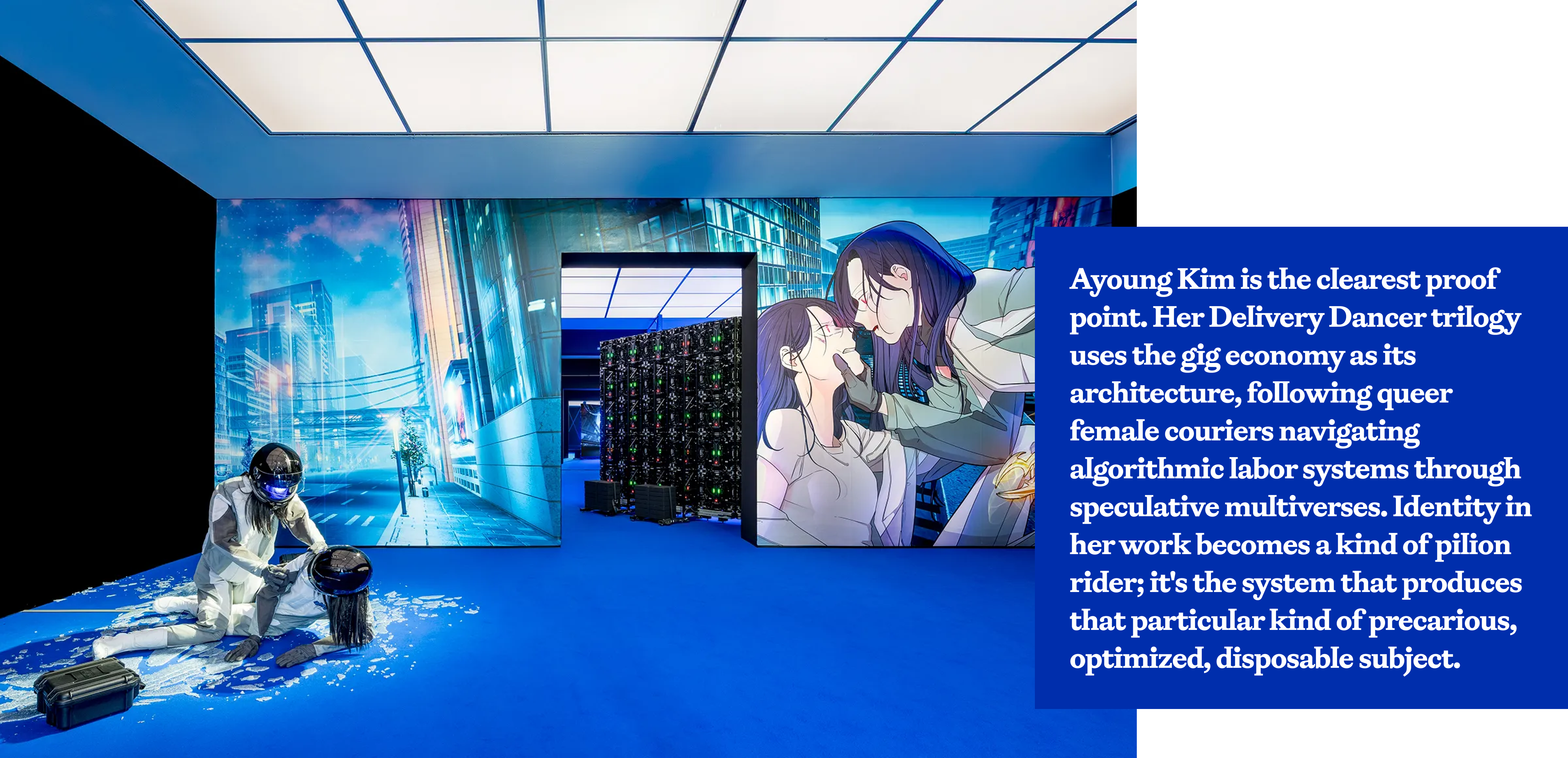
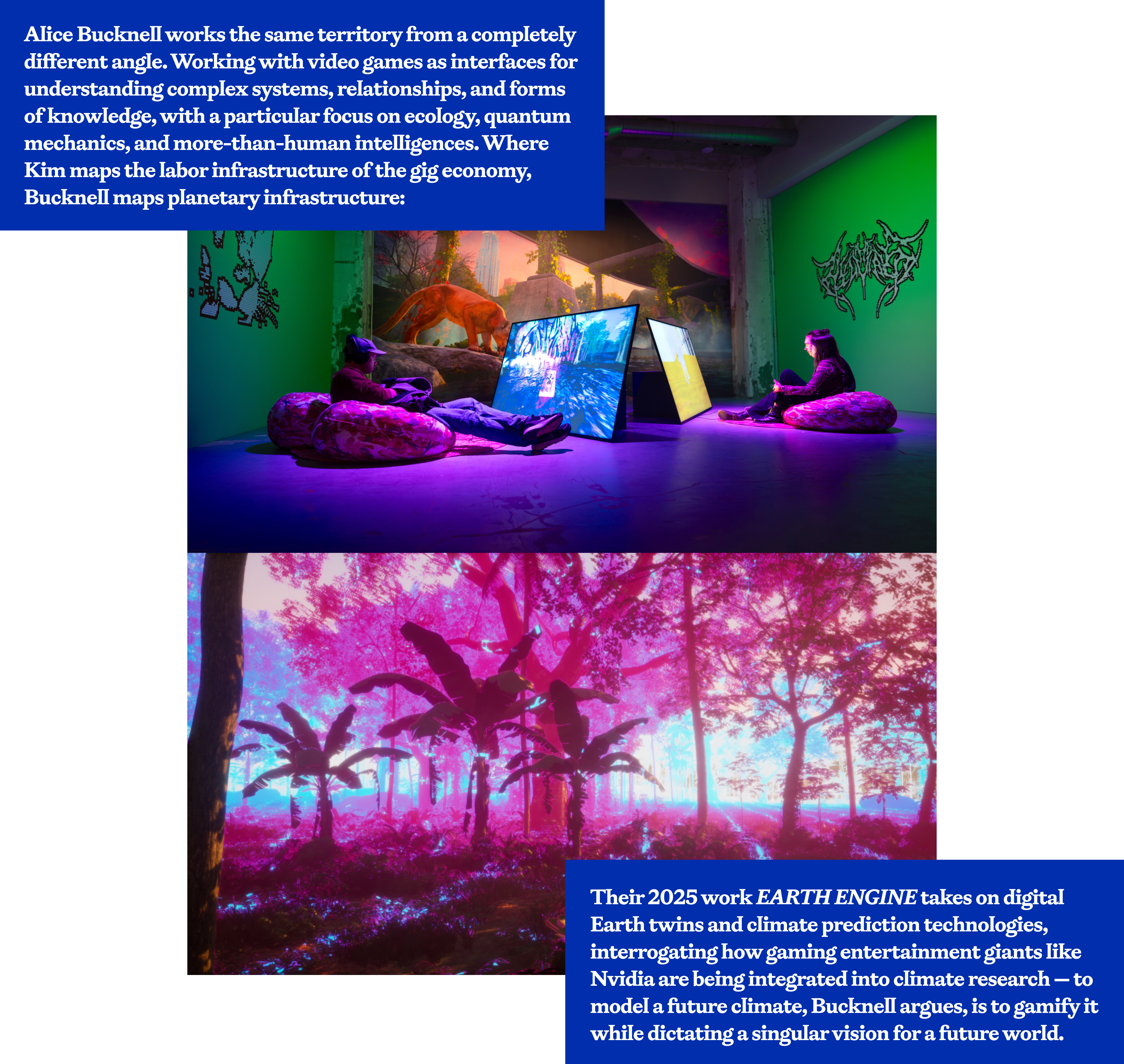
The questions it’s asking are the actual questions of the moment. When the infrastructure of existence is increasingly what determines life chances, art that makes that infrastructure visible and subvertable becomes more necessary than ever. The shift from identity to systems becomes a more precise political instrument. Identity told us who was marginalized. Systems asks what is doing the marginalizing, and whether we can break it open.
But there’s a necessary caveat. Systems-oriented art carries its own risk of co-optation, perhaps a deeper one than identity work, because it can be absorbed as methodology rather than just content. The art world is itself a system, and systems thinking is already becoming a curatorial language, a grant category, a fair programming strategy. Poliks and Trillo’s Exocapitalism (2025) offers the useful diagnosis here: capital has outgrown human control and governs itself, mutating faster than any critical apparatus built to contain it. The machine assimilates the map of the machine and adds it to the collection. The most urgent question for artists working in this mode is whether systems thinking can stay sharp once it goes mainstream.
Joseph Chen:
The art world is currently suffocating under the burnout of the didactic and criticality. Exhibitions have been checking boxes of diversity and inclusion, claiming to make social and environmental critiques, which drove to an overload of intellectualizing.
Audiences are looking for another way to connect to art with sense and affect. Because of that, vibe- and mood- setting is becoming a new tendency in contemporary art.
By creating augmented atmospheric environments, many new exhibitions modulate sensory, spatial, temporal, and material inputs, which create a kind of embodied experience (physical, emotional, and spiritual) that the audience can engage in their own way. Some leading artists include Pierre Huyghe, Anne Imhof, Álvaro Urbano, Mire Lee, Klára Hosnedlová.
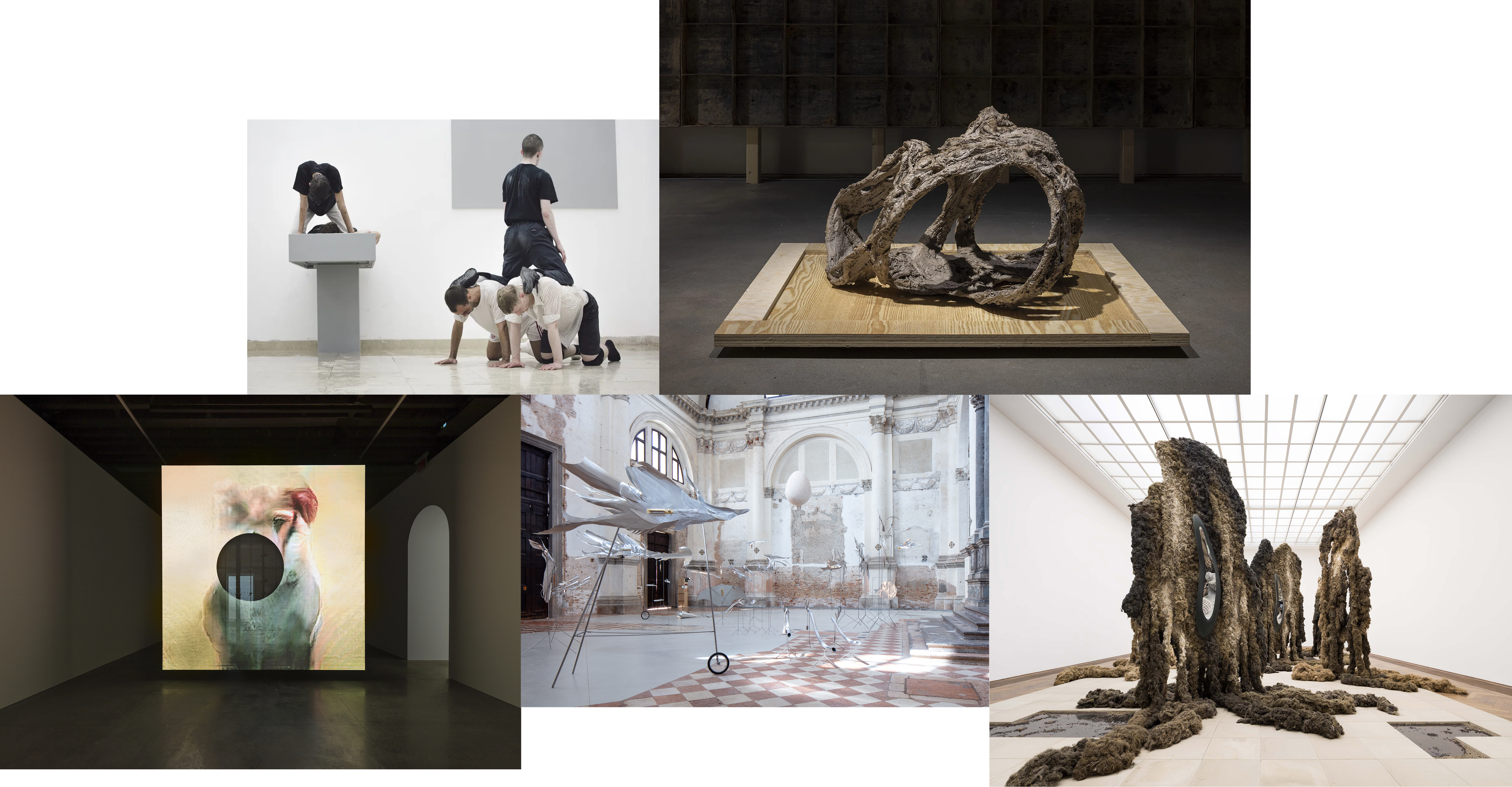
In this historical moment of artificial intelligence, artists are rethinking our relationship with art. If pursuing “intellect” is not the way, our living body is the last resort.
Eunice Tsang:
There already has been a renewed appreciation of craftsmanship.
There’s so much AI. We’re in this post-internet age where everything can be done on a laptop, or with a click of a button, where you can’t tell what is even being made by AI or humans anymore.
Whereas previously, if you were someone who made things with hands, you’re seen as a craftsman, not a contemporary artist. Now we’ll return to an appreciation of handicraft. For me, I absolutely enjoy little surprises or mistakes or unexpected things that happen when you make things with your hands. They show the rawness and humanness in our art.
I also think that there is a growing appreciation for communal art events. At Current Plans at least, we do coffee, communal cooking, and residencies. We host people. They can sleep here. Just like with handicraft, I personally appreciate the return to this chaos and messiness and rawness of human connection.

What I noticed during Hong Kong’s art month in March was the lack of Europeans and Americans. The visitor crowd’s overwhelmingly from China and probably Southeast Asia. A lot of Asian faces in general. I spoke to my friend Edouard from Kiang Malingue Gallery, and he said the reasons were geopolitics.
Galleries in Hong Kong especially, since it’s still one of the main markets in Asia, are trying to find ways to be less reliant on Western visitors. With the world (and other continents) being extremely volatile, foreign markets could shift at any time. It’s not dependable territory anymore. Whereas, I think Asia is looking to be much more stable.
You’re seeing this shift into artists from our region being represented and being marketed more. At Basel, the focus seemed to be on a lot of China-based artists. Buyers are also seeing the value and taking them more seriously. China’s not as isolated as it used to be; the global audience can relate to it a lot better. And recent shifts like China-maxxing impact the perception of artists in China.
I went to a few parties with a bunch of artists visiting from the Philippines, Malaysia, setting popups and doing satellite exhibitions as well. Even these visiting artists are overwhelmingly more and more Asian. As China’s influence starts increasing, you’re going to see other Asian countries piggybacking on that trend as well, which is kind of cool since I’m from Singapore. So not only will you see a shift in focus on China-based artists, but definitely Southeast Asia will be an important market to look into.